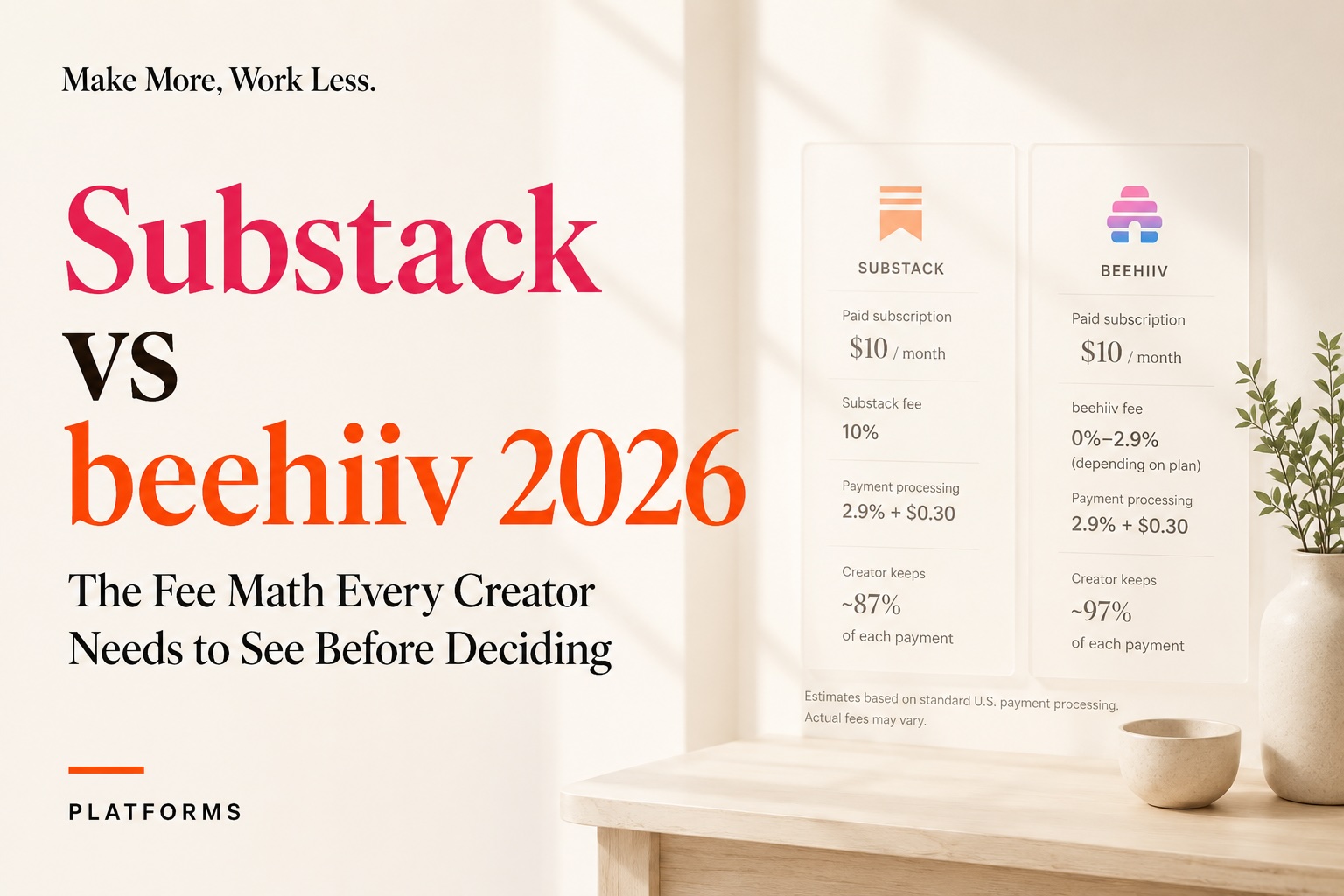
Substack vs beehiiv 2026: The Fee Math Every Creator Needs to See Before Deciding
By Carrie Loranger | Last updated: June 25, 2026
Substack and beehiiv are the two platforms creators compare most often in 2026 — and for good reason. The choice between them is worth hundreds or thousands of dollars per year. Substack charges 0% to publish but takes 10% of every dollar your paid subscribers send you, forever. beehiiv charges a flat monthly fee and takes 0% of subscription revenue. That math gap becomes real at $430/month in paid subscription revenue — and grows sharply from there. This article runs the numbers, compares every relevant feature, and gives you a decision framework based on where you actually are right now.
I'm Carrie Loranger — I run 9-to-Thrive at thrivewithcarrie.substack.com, where I've grown to 10,000+ subscribers in 15 months, and I've stayed on Substack deliberately. I also work with creators on Substack strategy and audits. I've done the fee math on my own business, and I'll show you exactly how I think about it.
What Is the Real Difference Between Substack and beehiiv in 2026?
The core difference between Substack and beehiiv in 2026 is how each platform makes money from you. Substack earns a percentage of your revenue every month — indefinitely. beehiiv earns a flat monthly subscription fee and takes nothing from your paid subscribers. Every other feature difference flows downstream from that structural distinction.
Substack is a publishing platform with a built-in reader network, Notes feed, and Recommendations system that drives organic discovery. Its business model is aligned with your growth: when you earn more, Substack earns more. That alignment comes at a cost — 10% of gross subscription revenue plus Stripe's \~2.9% + $0.30/transaction, totaling roughly 13–17% of every dollar your paying readers send you, depending on transaction volume.
beehiiv is an email-first newsletter platform built by the former team behind Morning Brew's internal tooling. It launched in 2021 and has grown into a serious infrastructure play: advanced automations, 3D analytics, a native ad network, Boosts cross-promotion, referral programs, and a flat-fee pricing model with 0% take rate on paid subscription revenue.
According to Readless, Substack crossed 8.4 million paid subscriptions in Q1 2026 — a 68% jump from 5 million in March 2025. beehiiv reported $28 million in total platform revenue for 2025 and targets $50 million in 2026, according to EMARKETER. Both platforms are growing. Neither is going anywhere.
How Does the Fee Math Actually Compare?
Substack's 10% fee becomes more expensive than beehiiv's $43/month Scale plan at exactly $430/month in paid subscription revenue. Below that number, Substack is cheaper. Above it, you are paying Substack more than you would pay beehiiv — and the gap widens every month as your revenue grows.
Here is the fee math at several revenue levels:
Fee Comparison Table: Substack vs beehiiv at Key Revenue Milestones
*beehiiv Scale pricing increases with subscriber count above 1,000 active subscribers. Stripe's \~2.9% + $0.30/transaction applies on both platforms. Fees shown are platform take only.
For 500 paying subscribers at $10/month ($5,000/month revenue), beehiiv saves approximately $600/month versus Substack, according to TechRadar's beehiiv review 2026. That is $7,200/year — real money that funds content, ads, or team.
The break-even math for Ghost is sharper: Ghost's Starter plan at $29/month becomes cheaper than Substack's 10% cut at roughly $290/month in subscription revenue. At higher revenues, Ghost is the most fee-efficient option of the three, though it requires the most technical setup.
Quick check: If you want to run your own numbers, the Newsletter Pricing Calculator shows your exact break-even point in about 30 seconds — free, no email required.
What Features Does Each Platform Include?
beehiiv includes more tools for list growth and diversified monetization. Substack includes a built-in discovery network that beehiiv does not replicate for free. These are meaningfully different strengths, and the right weight depends on where you are in your creator journey.
Full Feature Comparison Table: Substack vs beehiiv 2026
FeatureSubstackbeehiivPricing modelFree to publish; 10% on paid sub revenueFree tier (Launch); flat monthly fee (Scale/Max)Revenue share10% of paid subscriptions + Stripe fees0% (Stripe fees only)Free tierUnlimited subscribers, unlimited sends, free forever for free newslettersLaunch plan: up to 2,500 subscribers, unlimited sendsPaid tier pricing$0/month platform feeScale: $43/month (annual) or $49/month; Max: $96/month (annual) or $109/monthDiscovery / recommendationsBuilt-in Recommendations network — drives ~50% of all new subscriptions on the platformRecommendations (opt-in cross-promo) + Boosts (paid, $1–$3/subscriber acquired)Custom domain$50 one-time fee; note: connecting a custom domain removes you from Substack's internal recommendation networkIncluded on all plans, including the free Launch tierEmail automationsNone — every email is sent manuallyFull automation sequences on Scale and above (welcome flows, nurture sequences, segmentation triggers)AnalyticsBasic (open rate, subscriber growth, revenue)Advanced 3D analytics dashboard — opens, clicks, subscriber attribution, cohort dataMonetization optionsPaid subscriptions only (10% fee)Paid subscriptions (0% fee) + native Ad Network + Boosts cross-promotion + referral program + digital products + direct sponsorship storefrontNotes / social feedYes — Substack Notes is a built-in social feed driving engagement and discoveryNo equivalent social feedCommunity / chatNative chat and commentsComments onlyIntegrations / APIClosed ecosystem — limited integrationsOpen API + Zapier/Make webhooks + custom integrationsBest forEarly-stage creators prioritizing organic discovery and simplicityScaling creators prioritizing revenue efficiency, automation, and monetization diversity
Does Substack's Discovery Network Actually Matter?
Substack's Recommendations network drives approximately 50% of all new subscriptions on the platform — and that distribution is free. No equivalent organic discovery mechanism exists on beehiiv. This is the single most important advantage Substack holds over every competing platform for creators who are still in their growth phase.
When you publish on Substack, other Substack writers can recommend your publication to their readers. Those recommendations appear in Substack's onboarding flow, in the reader app, and via email. A single strong recommendation from a newsletter with 10,000–50,000 subscribers can add hundreds of free subscribers overnight. Lenny's Newsletter, one of the most-followed publications on the platform, has driven thousands of new subscribers to smaller newsletters through this mechanism.
beehiiv's equivalent is Recommendations (an opt-in co-promotion feature) and Boosts — a paid cross-promotion marketplace where you pay other newsletters $1–$3 per verified subscriber they send you. Boosts work, but they cost money. Substack Recommendations are free.
This matters most at the early stage. Once you have a large, engaged list that stands on its own — and once your subscription revenue crosses the fee threshold — the discovery network becomes less decisive. At that point, the economics flip.
My own publication, 9-to-Thrive, grew to 10,000+ subscribers in 15 months largely because of this network effect. That is the primary reason I have chosen to stay on Substack — not because of the fee structure (the math is real), but because the distribution advantage at my current stage outweighs the fee cost.
What Does beehiiv Do Better Than Substack?
beehiiv outperforms Substack on monetization diversity, automation depth, analytics, and data ownership. Creators who want to build a newsletter as a multi-channel media business — with ad revenue, referral systems, automations, and full subscriber data control — will find beehiiv's toolset significantly more capable.
Where beehiiv leads:
Ad Network — beehiiv distributes $1 million per month to creators through its internal ad network (brands include Notion, Google, Netflix, and HubSpot), with a 2026 target of $3 million per month, per EMARKETER. Substack has no native ad infrastructure.
Automations — welcome sequences, nurture flows, and segmentation triggers are native on beehiiv's Scale plan. Substack has none.
Referral programs — milestone-based referral systems (subscribers earn rewards for bringing in new readers) are built-in on beehiiv. Substack has no equivalent.
Analytics — beehiiv's 3D analytics tracks opens, clicks, subscriber attribution, and engagement cohorts. Substack's analytics are functional but basic.
Data ownership — full subscriber export, open API, and native integrations with Zapier and Make. Substack is a relatively closed ecosystem.
Custom domain at no extra cost — included on all beehiiv plans, including Launch. Substack charges a $50 one-time fee for a custom domain — and connecting it removes you from the internal recommendation network.
Creators on beehiiv who diversify across paid subscriptions, ad revenue, and Boosts earn roughly three times more than those who rely on a single stream, per self-reported data cited by EMARKETER.
What Does Substack Do Better Than beehiiv?
Substack leads on organic discovery, zero-friction simplicity, and native community features including Notes, Chat, and Recommendations — all free with no monthly platform fee for free newsletters. For early-stage creators, these advantages are concrete and immediate.
Where Substack leads:
Recommendations network — the free cross-promotion system that drives \~50% of all new subscriptions on the platform. beehiiv's equivalent (Boosts) requires payment per subscriber acquired.
Notes — a built-in social feed for short-form posts, comments, and engagement. Notes has become a meaningful discovery layer that beehiiv does not replicate.
Zero monthly fee for free newsletters — if you are not monetizing yet, Substack costs nothing. beehiiv's free Launch tier has a 2,500-subscriber cap; after that, you pay $43–$49/month even if you have no paying readers.
Native community — chat, threaded comments, and a built-in reader app create stickiness that is difficult to replicate with third-party tools.
Simplicity — Substack is genuinely fast to set up and fast to publish on. There is almost nothing to configure.
Substack's platform has 100,000+ monetizing publications as of April 2026, according to Mental Momentum Research, and 8.4 million paid subscriptions in Q1 2026. The network effect is real and measurable. Among competing platforms, Kit (formerly ConvertKit) charges a flat monthly fee with 0% revenue share — similar to beehiiv — but lacks a native reader discovery network and is positioned more toward creator businesses than pure newsletters.
For more on how Substack's platform economics work from a creator standpoint, see Substack Pricing for Creators 2026.
The Platform Decision Matrix: Which Stage Are You In?
The Platform Decision Matrix is a three-stage decision guide I use when creators ask me whether to switch from Substack to beehiiv — or which platform to start on. The key variable is not features. It is your current monthly paid subscription revenue, because that number determines which platform's economics actually favor you. Here is the framework.
Stage 1: $0–$430/Month in Paid Subscription Revenue — Stay on Substack
At this stage, Substack's 10% fee costs you less than beehiiv's $43/month base. More importantly, you are still in early-stage growth, and Substack's free Recommendations network is your highest-leverage acquisition channel. Every dollar you avoid paying in platform fees is a dollar that doesn't matter if you haven't yet built a subscriber base that converts to paid.
Who this is: New creators, creators with free newsletters under 2,500 subscribers, or creators just launching paid subscriptions. The math is unambiguous below $430/month — Substack is cheaper. Stay put, build your list, and use the discovery network hard.
Stage 2: $430–$5,000/Month in Paid Subscription Revenue — Evaluate by Growth Source
At this stage, beehiiv costs less on fees, but the right answer depends heavily on where your subscriber growth is coming from. If Substack Recommendations or Notes are driving meaningful list growth, the value of that free distribution may outweigh the monthly fee savings — especially if you are not yet generating enough surplus revenue to fund paid Boosts on beehiiv.
Who this is: Creators earning $5,000–$60,000/year in subscription revenue who need to ask one diagnostic question: "What percentage of my new subscribers came from Substack's network in the last 90 days?" If the answer is above 30%, think carefully before leaving. If the answer is under 10%, run the numbers.
Stage 3: $5,000+/Month in Paid Subscription Revenue — Run the Full Fee Math
At this stage, letterbench.com's analysis is direct: "Pick beehiiv if you have (or expect) $5K+/year in paid subscription revenue." At $5,000/month, Substack is taking $500/month (plus Stripe fees) from your business every single month. beehiiv's platform cost at this subscriber volume is $43–$99/month. The annual difference exceeds $4,000–$5,000 in kept revenue.
Who this is: Established creators with 500+ paying subscribers at $10/month (or equivalent revenue at other price points) who have validated that their list is their own — not purely dependent on Substack's recommendation engine. At this stage, the business case for migration is clear. Run a full fee comparison using your actual subscriber count, price point, and growth source data before deciding.
How Does beehiiv's Pricing Scale as You Grow?
beehiiv's pricing is not a single flat number — it scales with your total active subscriber count. The $43/month figure applies up to 1,000 active subscribers (billed annually). Once you cross subscriber thresholds, your monthly cost increases. Understanding these tiers prevents fee-math surprises after migration.
According to beehiiv's support documentation, pricing tiers increase at 10K, 25K, 50K, and 75K subscribers. Per PriceWorld, here is what the Scale plan costs at subscriber milestones:
Active Subscribersbeehiiv Scale (Annual)beehiiv Scale (Monthly)Up to 1,000$43/month$49/monthUp to 2,500$60/month$69/monthUp to 5,000$77/month$89/monthUp to 10,000$94/month$109/monthUp to 25,000$146/month$169/monthUp to 50,000$172/month$199/month
Note: beehiiv counts total active subscribers (free + paid) against its tier thresholds — not just paying readers. A free newsletter with 8,000 subscribers would pay $94/month for the Scale plan, even with zero paid subscription revenue.
This is the critical nuance missing from most "beehiiv vs Substack" breakdowns. When comparing fees, use your total subscriber count — not just paid count — to calculate your actual beehiiv cost.
Frequently Asked Questions
Is beehiiv really free?
beehiiv's Launch plan is free for up to 2,500 subscribers with unlimited sends. Once you exceed 2,500 subscribers — or want to enable paid subscriptions, the ad network, automations, or Boosts — you must upgrade to the Scale plan at $43–$49/month minimum. There is no intermediate tier. The jump from free to paid is the largest single pricing cliff on beehiiv.
At what subscriber count should I switch from Substack to beehiiv?
The subscriber count is a secondary variable. The primary variable is paid subscription revenue. When your monthly paid subscription revenue exceeds $430, beehiiv's flat fee becomes cheaper than Substack's 10% cut — roughly 43 paying subscribers at $10/month. The subscriber count that triggers that breakeven depends entirely on your pricing and conversion rate.
Does beehiiv have a recommendation network like Substack?
beehiiv has two growth tools: Recommendations (an opt-in cross-promotion feature where newsletters recommend each other) and Boosts (a paid marketplace where you pay $1–$3 per verified subscriber acquired). Neither replicates Substack's organic Recommendations network, which drives approximately 50% of all new subscriptions on Substack at no cost to the creator.
Can I stay on Substack and still be profitable as a paid newsletter?
Yes. Substack's 10% fee is a cost, not a barrier. Thousands of creators on Substack earn full-time income through paid subscriptions. The 10% becomes a meaningful drag only above the $430/month break-even threshold versus beehiiv, and above approximately $5,000/month in revenue, the economic case for switching becomes hard to ignore. Below those numbers, Substack's simplicity and discovery network often deliver more value than the fee saves. See How Many Substack Subscribers to Make $1,000/Month for a detailed breakdown.
What is the break-even point between Substack and Ghost?
Ghost charges 0% on subscription revenue and starts at $29/month for its Starter plan. That means Ghost's platform cost becomes cheaper than Substack's 10% cut at approximately $290/month in subscription revenue — lower than the Substack-vs-beehiiv break-even of $430/month. Ghost requires more technical setup than either Substack or beehiiv and lacks a native reader discovery network.
Does beehiiv integrate with Stripe the same way Substack does?
Both platforms route paid subscriptions through Stripe. On beehiiv, Stripe's standard fees (\~2.9% + $0.30/transaction) apply, and beehiiv adds 0% on top. On Substack, Stripe's same fees apply, and Substack adds 10% on top. The net result: beehiiv subscribers keep approximately 10 percentage points more of each transaction, per beehiiv's comparison page.
Which platform is better for a creator just starting out?
Substack. The zero monthly fee, instant setup, and free Recommendations network are strong advantages when your list is small and unmonetized. There is no penalty for staying on Substack early — the fee only activates when you earn, and the network can accelerate your growth in ways that take months or years to replace on beehiiv. Start on Substack, learn your audience, and re-evaluate once you cross the break-even threshold.
Can creators use both platforms at the same time?
Technically yes, but it is operationally complex and creates audience confusion. Most creators who use both are cross-posting free content to Substack for discovery while running their paid subscription on beehiiv. This hybrid is niche and not recommended for most creators. The cleaner path is to pick one platform based on your current stage and migrate deliberately when the numbers justify it.
The Pricing Playbook: How to Know If You Should Switch
If you are sitting somewhere in Stage 2 — earning between $430 and $5,000/month in subscription revenue — the right answer is rarely obvious from a feature comparison. The math depends on four variables specific to your business: your subscription price, your conversion rate, your total subscriber count, and what percentage of your growth is coming from Substack's network.
I wrote the Newsletter Pricing Playbook ($37) to give creators a structured framework for running this math — along with the pricing strategy decisions (what to charge, when to gate content, how to build a founding member tier) that determine whether you reach the break-even threshold at all. The platform you are on matters less than what you charge and how you convert free readers to paying ones. See also How to Make Money From a Newsletter for the broader monetization framework.
Resources to Go Deeper
Free:
Newsletter Pricing Calculator — Run your exact break-even numbers in 30 seconds
Secret Substack Society — Carrie's free Skool community for Substack creators
Paid:
Newsletter Pricing Playbook ($37) — The pricing math and conversion strategy for newsletter creators
From Zero to $100 ($9.99) — First revenue guide for new creators
Substack Audit ($450) — A full strategic audit of your Substack with Carrie
Subscribe to 9-to-Thrive at thrivewithcarrie.substack.com — published every Tuesday and Saturday.

