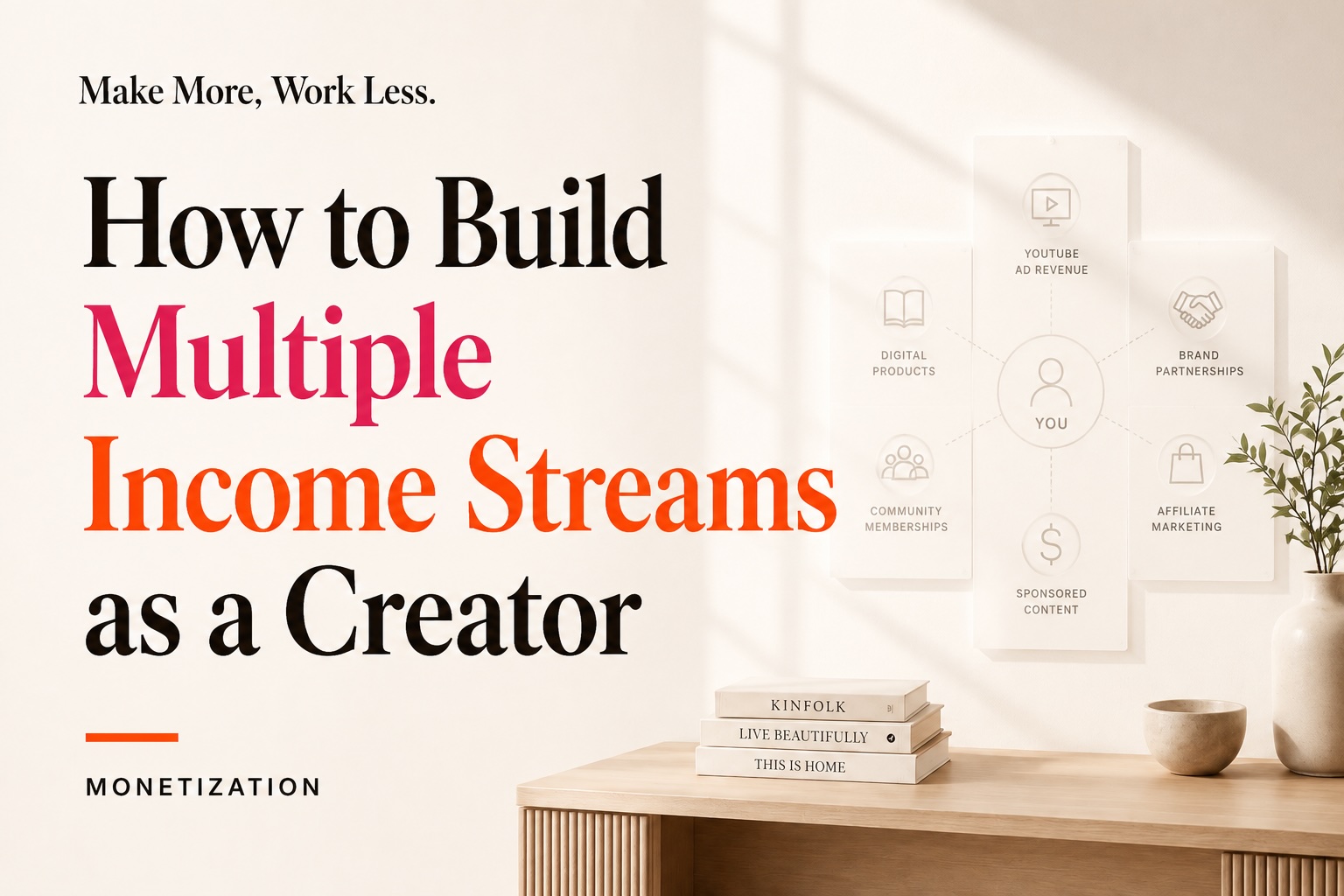
Multiple income streams as a creator: Portfolio of Paychecks
By Carrie Loranger | Last updated: July 2026
A portfolio business model is a strategy in which a solo creator or solopreneur builds multiple complementary income streams from a single central asset — typically an audience or newsletter — rather than depending on one revenue source. It works the same way a financial portfolio works: diversification reduces risk, smooths income, and compounds over time.
This is not a side-hustle strategy. It is a deliberate business architecture. Instead of scaling headcount or chasing one revenue stream to exhaustion, you build 4–6 interlocking streams that feed from the same audience, expertise, and content — and that all reinforce each other. When one stream has a slow month, the others carry the load.
I've built this model inside my own Substack publication, 9-to-Thrive, combining a free newsletter, a paid tier, digital products, client audits, affiliate income, and a community. None of those streams is the business. Together, they are.
What Is a Creator Portfolio Business Model?
A portfolio business model is a structure in which one person generates revenue from 4–6 complementary income streams tied to a single area of expertise. Rather than building separate businesses, you build one audience and one brand, then create multiple ways for that audience to pay you. The newsletter (or content hub) is the engine. The income streams are the outputs.
This is distinct from having multiple jobs or freelance clients. In a portfolio business, every stream feeds from the same trust you've built in one place — your list, your brand, your expertise. A digital product sells to the same people who read your newsletter. A paid community serves the same readers who bought your course. An affiliate recommendation goes to the same audience that opened your last email.
The model is gaining traction because single-stream creator businesses are fragile. According to EarnifyHub's 2026 survey of 1,000+ monetized creators via TechForDev, 73% of solopreneurs rely on just 1–2 income streams — and those creators earn a median of $2,400/month. The 27% who build 5+ streams earn a median of $11,200/month and experience 83% less income volatility.
How Is a Portfolio Business Different From a Side Hustle?
A side hustle is an additional income source you add alongside a primary job or business, usually without a strategic connection between the two. A portfolio business is a primary business structure — every income stream is intentionally connected to the same audience and expertise, and the streams reinforce each other.
In a side hustle, you might sell handmade goods and also do consulting — two unrelated activities. In a portfolio business, your newsletter builds the audience, your digital product converts them, your paid community retains them, your affiliate recommendations monetize their tool decisions, and your audit service upsells the most committed readers. Every stream feeds from and strengthens the others.
Side hustles are additive. Portfolio businesses are multiplicative.
Why Do Solo Creators Need a Portfolio Business Model?
Solo creators need a portfolio business model because single-stream businesses are both fragile and low-earning. The creator economy is large — valued at over $300 billion in 2026 and growing at 23% annually — but income is deeply unequal. More than 50% of creators earn under $15,000 per year. Only 4% earn over $100,000.
The difference between the top tier and the middle isn't audience size. It's revenue architecture. Creators maintaining 3+ revenue streams earn an average of $132,000 per year versus creators with a single income source. That gap is strategy, not talent.
There is also a resilience argument. Platform algorithms change. Sponsorship budgets get cut. A paid subscription tier that plateaus doesn't mean the business is over — it means one stream needs attention while the others keep running. According to the Influencer Marketing Factory's 2026 Creator Economy Report, passive revenue streams (digital products and affiliate) now account for 21.2% of creator income — a figure that has been climbing as creators deliberately shift away from brand-deal dependency.
What Income Streams Does a Portfolio Business Include?
A portfolio business for solo creators typically includes 4–6 streams across three categories: audience-based, product-based, and service-based income. The right combination depends on your audience size, how you like to work, and what your readers need most.
Here are the six most common streams for newsletter-driven portfolio businesses:
According to ea-nasir.co's solopreneur revenue analysis, a productized service is the fastest path to $2,000/month (reachable with just 300–1,000 subscribers), while a paid newsletter tier typically requires 5,000+ free subscribers to reliably hit that same threshold. Knowing the right sequencing — not just the list of options — is what makes the portfolio model work. More on that in the framework below.
The Portfolio of Paychecks Model
The Portfolio of Paychecks Model is a five-layer framework for building a sustainable solo creator business from one newsletter audience. Each layer builds on the previous one, and the layers are designed to compound: a stronger trust layer means better conversion on the entry offer; a stronger entry offer funds the core income stack; a strong income stack makes the high-leverage layer viable.
The model is intentionally sequential. You don't build all five layers at once. You build them in order, validate each one, and only add the next when the previous layer is producing reliably.
Layer 1: The Audience Asset
Your newsletter — specifically your email list — is the foundational asset of the entire portfolio. Every income stream you build draws from it. Building a bigger, more engaged list is not a vanity metric; it is infrastructure investment. A 3,000-person email list with 40% open rates is more valuable to a portfolio business than 30,000 social media followers with no email relationship.
Publish consistently. Every issue builds trust. Every Note, post, or piece of content that brings in a new subscriber is adding to the asset base that will fund every other income stream. This layer is never finished — you grow the list continuously even as you build the other layers.
Layer 2: The Trust Layer
Free content — your newsletter issues, Substack Notes, podcast episodes, LinkedIn posts — is not a product you give away before selling. It is the direct proof of the value you provide. When a reader clicks a link to buy your $97 template, they are not making a first impression of you. They already have 12 issues in their inbox.
The trust layer is also the SEO and LLM layer. Free content that ranks in Google and gets cited by AI tools brings in cold traffic that wasn't on your list. A dedicated Substack drip campaign guide can capture search traffic and warm new subscribers into your ecosystem before they ever see an offer.
Publish on a schedule you can sustain for 18 months without burning out. That pace is the right pace.
Layer 3: The Entry Offer
The entry offer is your first paid touchpoint — a digital product, workshop, mini-course, or template priced at $27–$97. Its job is not to make you rich. Its job is to move a reader from "free subscriber" to "customer" — and that transition changes the relationship in ways that matter for everything downstream.
Buyers convert to your higher-ticket offers at dramatically higher rates than free subscribers who've never paid you. The entry offer is a trust accelerant. It's also your proof of concept: if people won't pay $47 for a targeted solution, they almost certainly won't pay $97 or $297 for something bigger.
Build your entry offer around the single most common problem your readers are actively trying to solve right now. Look at your most-replied-to newsletter issues. That's your entry offer.
Layer 4: The Core Income Stack
The core income stack is where the portfolio model starts to feel real. This is 2–3 primary income streams running simultaneously, each generating meaningful revenue on its own, and each reinforcing the others.
A common core stack for newsletter-driven businesses:
Paid newsletter subscription (recurring) + digital product suite (scalable) + audit or consulting service (high-margin, low-volume)
Paid newsletter subscription + community membership + affiliate income (passive)
Digital products + group program or cohort + affiliate income
The goal is to have at least one recurring stream (subscriptions, community), one scalable stream (digital products), and one high-margin stream (services or group programs). Recurring income is your floor. Scalable income is your growth lever. High-margin services keep cash flowing when the other streams are being built.
See my breakdown of how to build six income streams from one newsletter for specifics on sequencing and what each stream needs to work.
Layer 5: The High-Leverage Layer
The high-leverage layer is where you capture the most value from the trust and audience you've built. This includes: annual subscription tiers (which dramatically improve cash flow and reduce churn), founding memberships (which reward early believers and create social proof), group programs (which deliver high outcomes at high prices with manageable time), and licensing or content partnerships.
This layer is built last because it requires a track record. An annual tier needs enough paying subscribers to make it meaningful. A $1,500 group program needs testimonials from the entry offer and digital products. A licensing deal needs content that's already proven valuable.
Most creators try to build the high-leverage layer first. They launch the premium community before they have an audience that trusts them enough to join it. Build in order.
Who Is the Portfolio Business Model For?
The portfolio business model is for solo creators and solopreneurs who want to build a business — not just an income stream. It is specifically designed for people who want to stay solo. Not scale a team. Not build an agency. Not become a media company.
There are 29.8 million solopreneurs in the US generating $1.7 trillion in revenue, and the fastest-growing cohort within that group is creators who have deliberately decoupled income from time — through products, subscriptions, and communities that earn whether or not they're actively working that day.
The model works particularly well for:
Newsletter writers who want more than a paid subscription tier
Coaches and consultants who want to move from trading time for money to productized, scalable income
Creators who have an engaged audience but aren't sure how to monetize it beyond brand deals
Solopreneurs who've hit an income ceiling on one stream and need to build a floor under it
It is not the right model for someone who wants fast cash. The first stream (the entry offer) can be built in 30 days. The full five-layer model typically takes 18–36 months to mature. The payoff is a business where no single revenue source represents more than 30–35% of total income — which means no single platform, algorithm change, or slow season can take the whole thing down.
How Does a Substack Newsletter Fit Into a Portfolio Business?
A Substack newsletter functions as both the trust layer (Layer 2) and the audience asset (Layer 1) of a portfolio business. It is the hub that all other income streams flow from. You write the newsletter; the newsletter builds the list; the list buys the products, joins the community, books the audits, and generates affiliate clicks.
Substack specifically is useful for portfolio businesses because it has a built-in paid subscription tier, native audio and video, a community comments section, and a recommendations network that helps grow the list. See how Substack's pricing models work for the math on what different pricing strategies produce at scale.
The important clarification: your Substack is not the portfolio business. It is the engine of it. The mistake most newsletter creators make is optimizing for Substack metrics (subscribers, open rates, paid conversions) without building the broader portfolio those metrics fund. A 10% paid conversion rate on a 3,000-person free list generates roughly $1,500–$2,500/month from subscriptions alone. A portfolio business with that same list and three additional streams generates $6,000–$12,000/month — and can sustain itself even if the paid tier stalls.
For a full breakdown of what each income stream looks like in practice, read how to make money on Substack — including the specific sequencing for small, medium, and large lists.
Offers to Help You Take the Next Step
Ready to build your own income stack?
Substack Audit ($450) — get a clear picture of what's blocking your revenue right now
$20K Offer Stack Academy ($597) — the structured program for building your multi-stream income system
Mini Monetization Toolkit ($19.99) — fast-start tools for your first income layer
Start Building Your Portfolio Business
The portfolio model works whether you have 300 subscribers or 30,000. The entry point is different; the architecture is the same. Start with the audience asset (your newsletter), build the trust layer (consistent free content), then add the entry offer. Everything else follows from there.
If you want a weekly breakdown of how this works in practice — what's working in my own portfolio business, what I'm building next, and the strategic framework behind it — subscribe to 9-to-Thrive on Substack. It's free. Issues go out every Tuesday.
Frequently Asked Questions
What is a portfolio business model?
A portfolio business model is a structure where one person generates revenue from multiple complementary income streams tied to a single area of expertise and audience. Instead of building several separate businesses, you build one brand and one audience, then create multiple ways for that audience to engage and pay. The newsletter or content hub is the central engine; income streams like digital products, subscriptions, services, and affiliate income are the outputs.
How is a portfolio business different from a side hustle?
A side hustle is an additional income source, often unrelated to your primary work. A portfolio business is an intentional business architecture where every income stream connects to the same audience, expertise, and brand. In a portfolio business, streams reinforce each other — your newsletter builds trust, your digital product converts readers, your community retains them, and your affiliate recommendations monetize their tool decisions. Side hustles are additive. Portfolio businesses are multiplicative.
How many income streams should a solopreneur have?
Four to six income streams is the target for a mature portfolio business. According to creator economy research, creators maintaining 3+ revenue streams earn an average of $132,000/year, while single-stream creators earn far less. More than six streams dilutes focus without meaningfully reducing risk. Aim for at least one recurring stream, one scalable stream, and one high-margin stream — then add from there.
Can you build a portfolio business from a Substack newsletter?
Yes — a Substack newsletter is one of the best starting points for a portfolio business. It gives you the audience asset (your email list), the trust layer (consistent free content), and a built-in first monetization option (paid subscriptions). From there, you add digital products, a community, services, and affiliate income — all fed by the same newsletter audience. The newsletter is the hub; everything else connects to it.
What is a "portfolio of paychecks"?
A portfolio of paychecks is a phrase describing the end state of a portfolio business model: multiple income streams, each paying you on different schedules and through different mechanisms, so that your total monthly income is never dependent on any single source. A subscription pays monthly. A digital product sale pays at purchase. An affiliate commission pays on a delay. A service retainer pays on contract. Together they create a composite paycheck that is more stable than any single stream alone.
How long does it take to build a portfolio business?
The entry offer (Layer 3) can be built and sold within 30 days. The full five-layer portfolio model typically takes 18–36 months to mature. Solopreneur data shows that median time to $1,000/month is 6–12 months, while $10,000/month typically takes 2–5 years. The timeline depends on how consistently you publish, how specifically you solve a real problem, and whether you build streams sequentially (as the Portfolio of Paychecks Model recommends) rather than all at once.
About the Author
Carrie Loranger is a Substack strategist and portfolio business architect. She's the creator of the Portfolio of Paychecks system, which helps creators turn one newsletter into multiple income streams, and the founder of the Secret Substack Society on Skool. Named Most Influential CEO by CEO Monthly in 2025 and 2026, Carrie writes 9-to-Thrive at thrivewithcarrie.substack.com — 9,000+ subscribers in 15 months.

