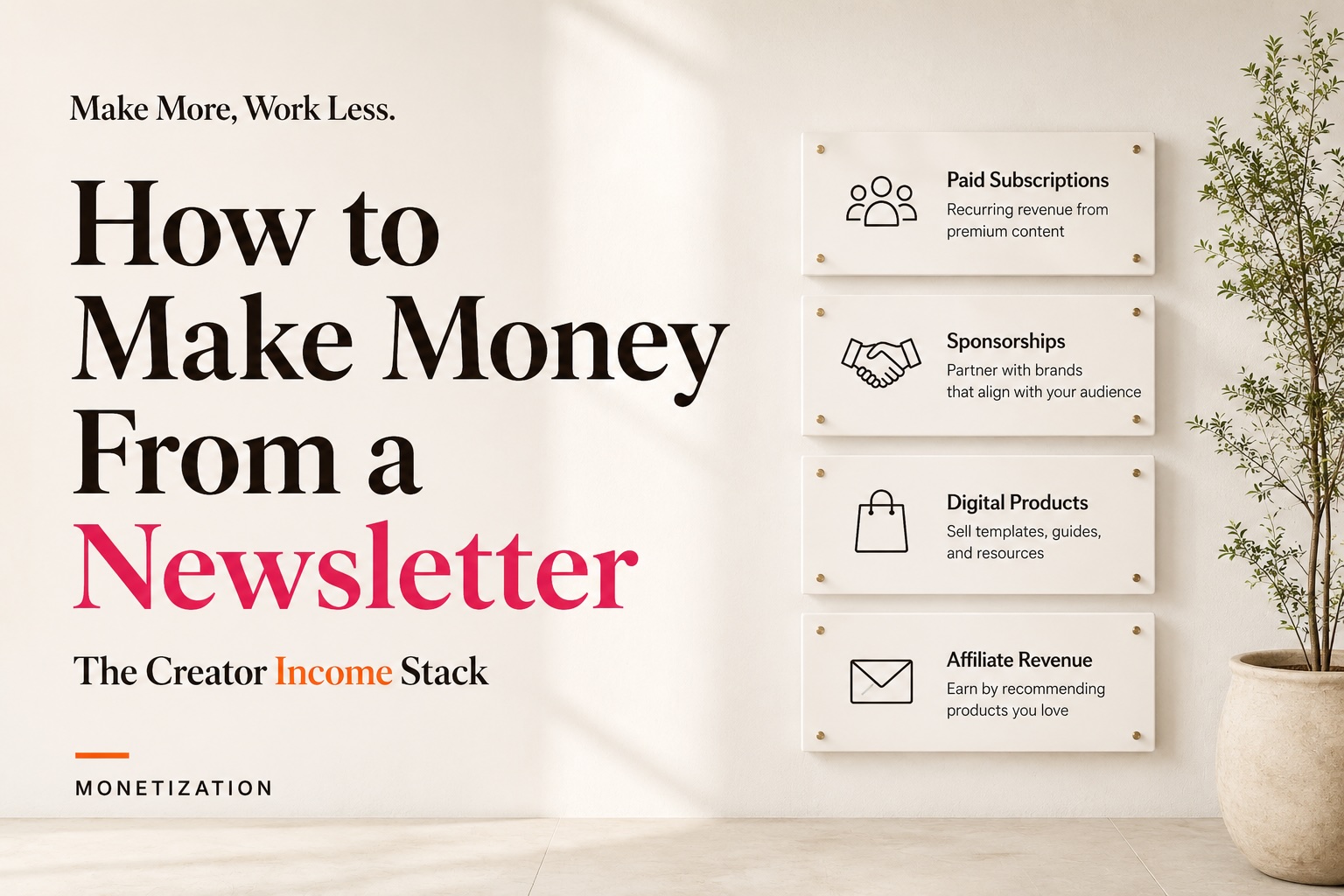
How to Make Money From a Newsletter (The Creator Income Stack)
By Carrie Loranger | Last updated: June 2026
You can make money from a newsletter through six income streams: paid subscriptions, digital products, services and consulting, group programs and communities, affiliate partnerships, and sponsorships. Most newsletter creators start with one stream and add more over time. The ones earning $5,000–$15,000/month consistently aren't doing anything extraordinary — they've built what I call the Creator Income Stack: a layered, sequenced set of revenue streams that all feed from the same newsletter audience.
Paid subscriptions alone are unlikely to get you there. Beehiiv's 2026 State of Paid Newsletters report found that the median free-to-paid conversion rate is 0.62% — meaning 1,000 free subscribers generates about six paying readers at $10/month, or $60/month gross. The newsletters earning real income don't rely on that number. They layer streams so the total adds up even when any single stream is slow.
This guide covers all six income streams, the math behind each, when to add them, and the exact sequencing that makes the whole system compound — drawn from my own experience building a multi-stream newsletter business on Substack.
What Are the Ways to Make Money From a Newsletter?
The six main ways to make money from a newsletter are: paid subscriptions, digital products (templates, guides, courses), services and consulting, group programs and community memberships, affiliate marketing, and sponsorships. Each stream has different audience-size requirements, time investment, and income ceilings. Most newsletter creators in the $5,000–$15,000/month range operate three to four of these simultaneously.
Here's the full picture before we go deeper on each:
How Does a Paid Newsletter Subscription Work?
A paid newsletter subscription charges readers a recurring monthly or annual fee — typically $7–$15/month or $70–$150/year — to access premium content, a paid archive, or exclusive benefits. Substack takes a 10% platform fee; Stripe takes approximately 2.9% + $0.30 per transaction. On a $10/month subscription, you net roughly $8.70 after fees.
The math matters here because it sets realistic expectations:
100 paid subscribers at $10/month = ~$870/month after fees
500 paid subscribers at $10/month = ~$4,350/month
1,000 paid subscribers at $10/month = ~$8,700/month
Per Creator Revenue Calculator's 2026 Substack breakdown, most creators reach $2,000–$10,000/month with 500–2,000 paid subscribers. The platform standard is $10/month / $100/year — it hasn't moved since 2024.
The honest constraint: Substack has 8.4 million paid subscriptions across the platform as of Q1 2026, but the median writer earns closer to $4,000 annually — not monthly. That gap exists because most newsletters rely on subscriptions as their only stream. The fix is adding more streams, not chasing more subscribers.
When to turn on paid: I recommend enabling a paid tier after you have 500–1,000 engaged free subscribers and have published at least 12 consistent issues. Before that, you're optimizing for conversion when you should be optimizing for trust.
How Do You Make Money From a Newsletter With Digital Products?
Digital products — templates, guides, mini-courses, toolkits, workshops — are the fastest way to generate meaningful revenue from a small newsletter audience. A 400-subscriber list that trusts you can generate more from a $97 template than a 4,000-subscriber list relying on subscriptions alone.
The reason is margin and conversion: digital products have 95%+ gross margin (no COGS, no per-unit costs), and buyers from a warm email list convert at 2–10% versus 0.5–2% from cold traffic. When you've built trust through your newsletter — and readers have seen your thinking in 20 issues — they already believe the product will help them before you write a single sales email.
What to sell: the single most useful digital product is a solution to the most common problem your readers email you about. Not what you want to teach — what they're actively asking you to solve. Look at your most-replied-to issues. That question is your product.
Common formats that convert well from newsletters:
Templates and swipe files — low price ($17–$47), high volume, fast to build
Standalone guides and playbooks — mid-price ($47–$97), solve one complete problem
Mini-courses or video workshops — mid-to-high price ($97–$297), higher production but higher trust signal
Toolkits and resource bundles — bundled price ($47–$147), easy to package from existing content
I sell digital products through Gumroad and host paid community content on Skool. Both integrate cleanly with Substack email links — a reader gets the newsletter, clicks the product link, buys without ever leaving their workflow.
How Do Services and Consulting Fit Into a Newsletter Business?
Services and consulting — audits, done-for-you work, coaching calls, fractional roles — are the fastest path to meaningful income from a small newsletter audience. A list of 300 highly engaged readers in a specific niche can reliably generate $3,000–$8,000/month from services alone, because you're not selling to everyone. You're waiting for the 1–3% who need your expertise delivered directly.
The newsletter's job here is proof of concept. Every issue you publish is a live demonstration of how you think, what you know, and what you can do for a client. By the time a reader books an audit call, they've already read 15 examples of your work. The sales conversation is short.
Services are also the best source of product ideas. Every client interaction reveals the questions people pay to have answered — and those questions become digital products, course modules, and paid newsletter content that scale beyond your time.
I run Substack audits directly from my 9-to-Thrive newsletter audience. Readers who've followed the newsletter for months reach out because they've already seen what I know. No cold outreach, no ad spend. The newsletter does the qualification.
The limitation is time. Services are high-margin but not scalable — you can only take on so many clients. That's why I treat services as Layer 1 of the income stack: the cash engine that funds the time to build the scalable layers.
What Is the Creator Income Stack?
The Creator Income Stack is a sequenced framework for building multiple newsletter income streams in the right order, so each layer funds and supports the next. The five layers are: (1) Service Income, (2) Digital Products, (3) Paid Subscriptions, (4) Community or Group Program, and (5) Passive Income (affiliate + sponsorships). You build them sequentially. You don't launch all five at once.
Here's why sequence matters: most newsletter creators try to start with passive income (subscriptions, affiliates, sponsorships) before they've built enough trust or audience for those streams to perform. They get discouraged when 500 subscribers generates $150/month in subscription revenue. The Creator Income Stack builds in the opposite direction — start with the high-margin, low-volume stream (services) that works at any list size, use it to fund the time to build the scalable layers, and add passive streams last when they have a real base to perform against.
Layer 1: Service Income (Cash Engine)
A productized service — a Substack audit, a newsletter setup sprint, a consulting retainer, a done-with-you offer — is the fastest path to meaningful income at any list size. This stream works with 200–500 subscribers because you're not relying on volume. Two or three clients at $500–$2,000 each generate $1,000–$6,000/month immediately, and the insights from those engagements inform every other income layer you build after it.
Layer 2: Digital Products (Scalable Proof)
Digital products — templates, guides, mini-courses, toolkits — are the scalable version of your service work. Where services trade your time for income, a digital product sells the same expertise in a self-serve format, at 95%+ margin, to as many buyers as your list can support. This layer proves that your audience will buy from you without a sales call, which is the prerequisite for everything downstream.
It also does something subtler: it moves free subscribers into the "buyer" category. Buyers convert to higher-ticket offers at dramatically higher rates than subscribers who've never paid you.
Layer 3: Paid Subscriptions (Recurring Floor)
A paid subscription tier is most effective after you have an engaged free list, proven content, and at least one paid product that's confirmed your readers will pay for your expertise. Turning on paid too early leads to low conversion and discouragement — the timing matters as much as the mechanics.
At $10/month with 500 paid subscribers, you net approximately $4,350/month after Substack and Stripe fees. That's a reliable recurring floor to build from — but it's the third layer, not the first.
Layer 4: Community or Group Program (Retention Engine)
A community membership or cohort-based program is where retention compounds. Readers who join a community stay longer, refer more people, and buy more products than free subscribers who never take a step deeper. Beehiiv's 2026 data shows that subscriber lifetime varies from 6 months (money niche) to nearly 20 months (food and drink) — community almost always extends that lifetime.
I run my own community — the Secret Substack Society — on Skool, which handles payments, content, and community in one place. It's the fourth layer in the Creator Income Stack for a reason: communities perform best when members already know and trust you from the earlier layers.
Layer 5: Passive Income — Affiliate and Sponsorships (Scale Layer)
Affiliate income and sponsorships are the last layer to build — not because they're less valuable, but because they require audience trust and size to perform well. Affiliate links in a 500-person list generate almost nothing. The same links in a 5,000-person list with high open rates and strong trust can generate $1,000–$5,000/month from recommendations you were already making.
Sponsorships require more audience (typically 3,000+ free subscribers minimum for most sponsors) but offer the highest single-stream ceiling — up to $50,000/month for large newsletters in premium niches. Both streams work best as additions to an already-functioning stack, not as the first thing you build.
How Much Money Can You Actually Make From a Newsletter?
A newsletter generating income from three or more streams — paid subscriptions, digital products, and services — can realistically reach $3,000–$8,000/month with 2,000–5,000 free subscribers. The ceiling is much higher with larger audiences and five-layer stacks, but the floor is accessible earlier than most creators expect.
The honest benchmarks from 2026 data:
Beehiiv's State of Paid Newsletters: paid subscription revenue on the platform grew 138% in 2025; median time to first dollar dropped to 66 days
Substack's platform total: 8.4 million paid subscriptions as of Q1 2026; 52 newsletters earn $500,000+/year; median paid writer earns ~$4,000 annually (subscription-only)
Creator Revenue Calculator: creators in the $2,000–$10,000/month range typically have 500–2,000 paid subscribers — but that's subscriptions alone
The pattern across every newsletter creator I know who earns $5,000+/month: subscriptions are not the main revenue driver. They're the reliable floor. Products, services, and community are the ceiling-lifters.
How Do You Make Money From a Newsletter With Sponsorships?
Sponsorships pay a fixed fee — typically calculated per 1,000 subscribers (CPM) or per issue — for a dedicated placement in your newsletter. Industry CPMs range from $20–$50 for general audiences to $100–$200+ for highly targeted professional niches. A newsletter with 10,000 subscribers and a $40 CPM earns $400 per dedicated sponsorship placement.
The prerequisite is audience clarity, not audience size. Sponsors pay premiums for specificity. A 3,000-subscriber newsletter reaching senior marketing leaders at SaaS companies commands a higher CPM than a 30,000-subscriber general business newsletter with a vague audience profile.
What sponsors actually ask before signing:
What is the niche, and how tightly defined is it?
What are the open rates and click rates?
Who are the readers? (Job title, company size, budget authority)
What have past sponsors seen in terms of results?
Start building the answers to those questions now — even before you're actively pitching sponsors. Document your audience demographics, track your open and click rates, and note any organic mentions of tools or brands your readers already use. When you're ready to pitch, the answers are already there.
I don't actively pursue sponsorships for 9-to-Thrive yet — my audience is still growing into the size that commands meaningful CPMs. But affiliate income from tools I already recommend (and use) generates revenue from the same trust relationship without the minimum audience threshold.
What Is Affiliate Income for Newsletter Creators?
Affiliate income is commission earned when a reader clicks your link and purchases a product or service you've recommended. Commission rates vary: digital tools and SaaS products typically pay 20–50% recurring commission; physical products pay 3–15%; courses and programs often pay 30–50% of purchase price. For newsletter creators in tool-heavy niches, affiliate income compounds quietly in the background of every issue.
The reason affiliate income works for newsletters is trust density. Your readers have opened 20 or 40 of your issues. They know you're selective about what you recommend. When you link to a tool you actually use, the conversion rate is dramatically higher than any display ad — because the recommendation comes from someone they've been reading for months.
What not to do: don't add affiliate links to everything. Readers notice when recommendations feel commercial. One well-placed, genuinely useful recommendation per issue outperforms five hedged ones. I only affiliate for tools I pay for myself and actively use in my Substack workflow — Substack, Midjourney, Skool, and a handful of others. That selectivity is what makes the recommendations land.
Disclose always. FTC guidelines require disclosure of affiliate relationships. A simple "This post contains affiliate links — I earn a commission if you purchase, at no extra cost to you" in the footer or near the link is sufficient and builds trust rather than eroding it.
How Do You Start Making Money From a Newsletter if You Have a Small Audience?
Start with services. A list of 200–500 highly engaged subscribers in a specific niche is enough to generate $2,000–$5,000/month from a productized service — an audit, a setup sprint, a coaching package. You don't need thousands of subscribers to sell something to the 2–3 readers who need your expertise right now.
The mistake most small-list creators make is waiting: waiting until they have 5,000 subscribers to turn on paid, waiting until they have 10,000 to approach sponsors, waiting to sell anything until the list "feels big enough." The Creator Income Stack runs in the opposite direction — start with the stream that works at any list size, learn from those buyers, and build toward the passive streams as the audience grows.
The sequencing matters more than most creators realize. There's a specific order that makes each stream easier to build and more likely to convert — starting with the stream that works at any list size and building toward the passive ones as trust and audience compound. If you want the exact sequence mapped to your current list size and what you're selling, that's exactly what I cover in the $20K Offer Stack Academy.
Offers to Help You Take the Next Step
Start building your newsletter income:
From Zero to $100: 5 Power Moves for Newsletter Monetization ($9.99) — the fastest path to your first dollar
Mini Monetization Toolkit ($19.99) — quick-start tools for turning a newsletter into income
Substack Audit ($450) — a full review of what's working, what's blocking revenue, and what to fix first
$20K Offer Stack Academy ($597) — build your full multi-stream income system
Build Your Newsletter Income — Start Here
If you want a weekly breakdown of how this works in practice — what's actually generating income in my own Creator Income Stack, what I'm testing, what failed, and what I'd do differently — subscribe to 9-to-Thrive on Substack. Free subscribers get every issue. Paid subscribers get the full strategy behind the numbers.
If you want a direct look at how your newsletter is set up to monetize — what's working, what's blocking revenue, and what to fix first — I also run Substack audits for newsletter creators ready to turn their list into a real business.
Frequently Asked Questions
How do you make money from a newsletter?
You make money from a newsletter through six streams: paid subscriptions, digital products, services and consulting, group programs or community memberships, affiliate marketing, and sponsorships. Most newsletter creators earning $5,000+/month use three to four streams simultaneously. Paid subscriptions alone — at the median 0.62% free-to-paid conversion rate — rarely produce full-time income without additional revenue layers.
How many subscribers do you need to make money from a newsletter?
You can start earning from a newsletter with as few as 200–500 engaged subscribers if you offer a service or digital product. Paid subscriptions become meaningful around 1,000–2,000 free subscribers. Sponsorships typically require 3,000–5,000+ subscribers. The income threshold depends more on niche specificity and trust than raw subscriber count — a 1,000-subscriber investing newsletter can earn more than a 10,000-subscriber general newsletter.
How much does a newsletter with 1,000 subscribers make?
A newsletter with 1,000 free subscribers and a 3% paid conversion rate at $10/month earns approximately $261/month from subscriptions alone (after Substack and Stripe fees). The same newsletter with a $97 digital product and a 2% conversion rate adds another ~$1,940/month. Combined with one or two service clients, total monthly revenue can reach $3,000–$5,000 from a 1,000-person list with the right income stack.
What is the best way to monetize a Substack newsletter?
The best way to monetize a Substack newsletter is to layer streams in sequence: start with a productized service to generate immediate cash, add a digital product once you understand what your audience pays for, then enable paid subscriptions, add a community, and build in affiliate income alongside each step. Multi-stream newsletter businesses consistently report that paid subscriptions account for a minority of total revenue — products, services, and sponsorships carry the ceiling.
How long does it take to make money from a newsletter?
Beehiiv's 2026 data shows the median time to first dollar dropped to 66 days for new creators. First service revenue can arrive within 2–4 weeks of launching if you're actively publishing and reaching out to your first subscribers. Meaningful recurring income — $1,000+/month from multiple streams — typically takes 6–12 months. Full-time income from newsletter businesses ($5,000+/month) most commonly arrives at the 12–24 month mark with consistent publishing and sequential stream-building.
What is the Creator Income Stack?
The Creator Income Stack is a five-layer framework for building newsletter income in sequence: (1) Service Income for immediate cash flow, (2) Digital Products as scalable proof of expertise, (3) Paid Subscriptions as recurring floor income, (4) Community or Group Programs for retention and premium revenue, and (5) Passive Income (affiliate + sponsorships) as the scale layer. Each layer funds the time and trust needed to build the next. The goal is a diversified revenue architecture where no single stream represents more than 30–35% of total monthly income.
Can you make passive income from a newsletter?
Yes — affiliate commissions and paid subscriptions are the most passive streams in a newsletter business. Affiliate links placed in older issues keep generating commissions as new subscribers read the archive. Paid subscriptions renew automatically each month. Digital products sold through an automated email sequence earn without active selling. The catch: the content creation that builds the list is not passive. The income streams become increasingly passive over time as the audience and trust compound.
About the Author
Carrie Loranger is a Substack strategist and portfolio business architect. She's the creator of the Portfolio of Paychecks system, which helps creators turn one newsletter into multiple income streams, and the founder of the Secret Substack Society on Skool. Named Most Influential CEO by CEO Monthly in 2025 and 2026, Carrie writes 9-to-Thrive at thrivewithcarrie.substack.com — 9,000+ subscribers in 15 months.

