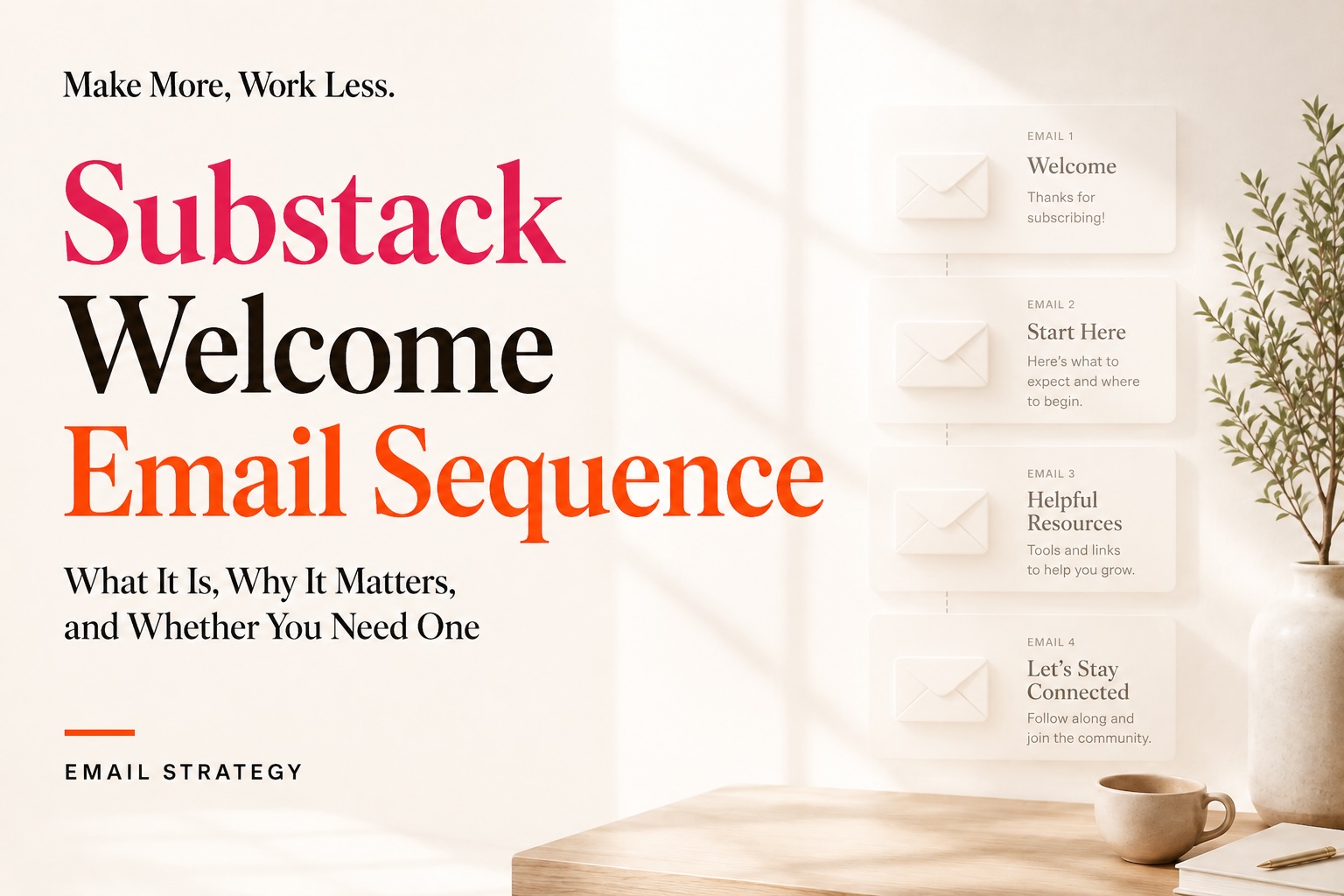
Substack Welcome Email Sequence — What It Is, Why It Matters
By Carrie Loranger | Last updated: June 25, 2026
Substack now gives creators two layers of new-subscriber communication: a single welcome email (available for years) and a multi-email drip campaign sequence (launched in beta in October 2025, now rolling out broadly in 2026). If you have a free list and you want to convert more of those readers to paid — or simply onboard new subscribers so they stick around — a Substack welcome email sequence is the highest-leverage automation you can build. Research from Omnisend shows automated welcome emails achieve an average open rate of 83.6% — the single highest open rate of any email type. That window is where conversions happen.
What Is a Substack Welcome Email Sequence?
A Substack welcome email sequence is an automated series of emails sent to new subscribers in the days immediately following sign-up, designed to build trust, deliver value, and guide readers toward a clear next step — such as upgrading to paid. Until October 2025, Substack offered only a single welcome email per subscriber tier. The platform's new drip campaigns feature adds a multi-email automation layer on top of that, allowing creators to send a timed sequence without leaving Substack or connecting a separate email service provider.
The difference matters: a single welcome email is a handshake. A welcome email sequence is an onboarding experience.
What Are Substack's 5 Drip Campaign Types?
Substack launched five distinct drip campaign types in its late-2025 beta, now available to creators as the feature rolls out in 2026. Each campaign type targets a different stage of the subscriber journey.
According to Substack creator notes from October 2025, the free-to-paid conversion campaign effectively replaces the standard welcome email — if you activate it, it becomes the first touchpoint for every new free subscriber.
Before drip campaigns existed, Substack creators who wanted a multi-email welcome sequence had to connect a separate ESP — typically Kit (formerly ConvertKit) — via Zapier, creating a manual workflow to route new subscribers into an external automation. The native drip campaign feature eliminates that workaround for most use cases.
Single Welcome Email vs. Substack Drip Campaign: What's the Difference?
Choosing between a single welcome email and a full drip sequence is the decision most Substack creators face in 2026. Here is how the two options compare across the metrics that matter.
The revenue gap between a single email and a sequence is not subtle. Klaviyo's welcome flow benchmarks show well-built welcome sequences convert 8–12% of new subscribers within 14 days, compared to 2–4% for a single-email welcome.
Why Does a Substack Welcome Email Sequence Matter for Conversions?
A Substack welcome email sequence matters because the window of highest subscriber engagement is the first 7–14 days after sign-up — and most creators let that window close without a structured plan. New subscribers are actively watching their inbox. They remember signing up. They want to hear from you. After two weeks, that attention degrades sharply.
Backlinko's email marketing statistics confirm welcome emails generate an average 5.1× the click-through rate of a regular newsletter send. That multiplier exists in the first few days — then it's gone.
In my own Substack audit work with clients across dozens of niches, the creators who convert the most free subscribers to paid share one trait: they have a deliberate welcome experience that delivers a clear reason to upgrade before the new-subscriber curiosity fades.
The Substack Welcome Window: A 3-Phase Framework
The Substack Welcome Window is a framework for understanding the three phases of the new subscriber relationship — what each phase demands, and what you risk losing if you ignore it. Each phase has a distinct conversion psychology that your drip campaign should address.
Phase 1: The First 24 Hours (Trust Signal)
In the first 24 hours, a new subscriber is asking one question: "Did I make the right call?" Your job is not to sell — it is to confirm they belong here. Deliver your single best piece of existing content, introduce yourself in one concrete sentence, and set expectations for what comes next. This email has the highest open rate you will ever achieve with this person. Mailsoftly research shows the first email in a welcome sequence sees 70–86% open rates — treat it accordingly.
Phase 2: Days 2–7 (Value Proof)
Days 2–7 are your proof-of-concept window. The subscriber is still in the "get to know you" phase, but the excitement of Day 1 is fading. This is when you demonstrate — not declare — your value by delivering 2–3 pieces of your best thinking, a perspective they can only get from you, or a quick win they can act on. Each email in this phase earns the next one. ESC Hub's research on nurture sequences notes the highest-engagement window is 7–14 days post opt-in — emails sent in this period consistently outperform those sent later to the same subscriber.
Phase 3: Days 8–14 (The Conversion Window)
Days 8–14 are when free-to-paid conversion is most likely to happen. The subscriber now has enough context to evaluate the paid offer. This phase is where your welcome email sequence pays for itself: introduce your paid tier, articulate the specific transformation it delivers, and make the upgrade feel like the obvious next step — not a pitch. Email Optimize's Klaviyo benchmark data confirms that well-structured welcome flows convert 8–12% of new subscribers within this window, compared to under 4% for creators using only a single welcome email.
Why Substack Launched Drip Campaigns Now
Substack began beta-testing drip campaigns in October 2025, as reported by creator Lia Haberman who noted it as a major shift from newsletter platform to something resembling a full email marketing platform. The feature went to a small group of "bestsellers" — creators already generating significant paid subscription revenue — before broader rollout in 2026.
The strategic reason is straightforward: Substack earns 10% of paid subscription revenue. Every percentage point improvement in free-to-paid conversion rates directly improves Substack's business. Giving creators better onboarding tools is not altruism — it is aligned incentive. Substack's own platform positioning has consistently moved toward reducing the need for external tools.
For creators, the business case is equally clear. According to research aggregated by Digital Applied, 34% of subscribers expect a welcome email within 24 hours. Creators who do not meet that expectation lose the highest-engagement moment in the subscriber relationship.
Does the Substack Welcome Email Sequence Replace the Old Welcome Email?
Yes — partially. When you activate Substack's Free-to-Paid Conversion drip campaign, it replaces the single welcome email for new free subscribers. The sequence begins with what would have been your welcome email and adds subsequent emails on a timed schedule.
For creators who have already written a strong single welcome email, this is not a "start over" situation. The existing email becomes Email 1 of your sequence. The drip campaign layer adds the follow-up touches that the single email could never send.
Substack's original welcome email system (Settings → Branding) supports four trigger types: free subscriber, paid subscriber, imported subscriber, and founding subscriber. The new drip campaigns expand on the free and paid categories with multi-email sequences and timed delivery.
What Are the Limitations of Substack Drip Campaigns in 2026?
Substack's drip campaigns are a significant step forward but are not a full ESP replacement — at least not yet. Understanding what is currently missing helps creators decide whether to go native or maintain an external workflow.
Current limitations reported by beta testers as of mid-2026:
No analytics dashboard — creators cannot easily view open rates, click rates, or conversion data per campaign email inside Substack
No behavioral triggers — sequences run on time-delay only; there is no "if opened, send X; if not, send Y" logic
No list segmentation — cannot target by subscriber interest, geography, or engagement level
No paywall within sequences — cannot gate a sequence email behind paid status
No "if-then" logic — customer journey branching is not available
These gaps matter if you are doing advanced conversion optimization. For the majority of Substack creators — especially those who have not yet set up any welcome sequence — the native tool is more than sufficient and removes the friction of an external integration entirely.
Should You Set Up a Substack Welcome Email Sequence?
If you have a free list and a paid tier, the answer is yes — the data is unambiguous. Research from HamsterStack's welcome sequence analysis shows welcome emails generate 320% more revenue than standard promotional emails. New subscribers are 4× more likely to engage with your content during the welcome window than after it closes.
The open rates alone justify the setup time. Welcome sequences achieve 50–86% open rates across benchmarks (Mailflow Authority), compared to 21–25% for regular campaigns. You will never have an audience this engaged with you again — not with these specific people.
If you run a free-only Substack and have no plans to monetize, a welcome sequence still matters for reducing early-subscriber churn, setting expectations, and building the relationship that makes your list responsive when you eventually do promote something.
The question is not whether to build a welcome email sequence. It is whether to do it now or after you have already let thousands of new subscribers pass through the window unaddressed.
If you want a structured path to building and writing your sequence — including knowing which emails to prioritize, how to frame the upgrade conversation, and what to say in each phase — the Subscribe Worthy Mini Course ($67) walks through exactly that.
How Does This Connect to the Bigger Substack Monetization Picture?
A welcome email sequence is not a standalone tactic — it is the entry point to a creator's entire conversion architecture. The free-to-paid conversion numbers that define whether a Substack publication is financially viable are largely set in the first 14 days. For more context on the revenue math behind those numbers, see How Many Substack Subscribers to Make $1,000/Month and the full breakdown of Substack Pricing for Creators 2026.
Creators building toward consistent revenue do not treat the welcome sequence as a "nice to have." They treat it as the first stage of their paid conversion system — the sequence that runs in the background, converting subscribers they will never personally pitch.
For more on the broader strategy of turning a newsletter into multiple income streams without building a media empire, How to Make Money on Substack Without Viral Numbers covers the full framework.
Frequently Asked Questions
What is the difference between Substack's welcome email and a drip campaign?
Substack's welcome email is a single automated message sent the moment a new subscriber joins. A Substack drip campaign is a multi-email sequence sent over days or weeks, with each email on a timed delay. Drip campaigns launched in beta in October 2025 and are now available to creators in 2026. When you activate the free-to-paid conversion campaign, it replaces the standard welcome email.
How many emails should a Substack welcome sequence include?
Most effective welcome sequences run 3–5 emails over 7–14 days. The first email should send immediately on subscribe. Subsequent emails can be spaced 2–3 days apart. Klaviyo's benchmark data shows well-built sequences of 3–7 emails consistently outperform single-email approaches, with welcome flows producing average placed-order rates above 2% per email.
Do I need Substack's drip campaign feature to run a welcome sequence?
No. You can set up a welcome sequence using Substack's original welcome email as Email 1, then connect Kit (formerly ConvertKit) via Zapier to send follow-up emails from an external platform. Substack's new native drip campaigns simply remove the need for that workaround. For most creators, the native tool is faster to set up and sufficient for core use cases.
When are new Substack subscribers most likely to convert to paid?
New subscribers are most likely to convert in the first 7–14 days. ESC Hub research on nurture sequences confirms this is the highest-engagement window — after two weeks without structured follow-up, most subscribers have mentally moved on. Conversion rates drop significantly beyond the two-week mark regardless of the quality of content sent later.
Is the Substack drip campaign feature available to all creators?
As of mid-2026, Substack's drip campaigns are rolling out beyond the original beta group, which was limited to "bestseller"-tier publications. Access is found at Dashboard → Settings → Emails → Drip Campaigns. Some creators report the feature is still not visible on their accounts; if unavailable, joining Substack's Product Lab testing group via [email protected] is the reported path to early access.
Does setting up a welcome email sequence require technical skills?
No. Substack's native drip campaign builder is a no-code tool within the standard dashboard. You write the emails in Substack's existing editor, set the timing delays, and activate the campaign. The only non-obvious step is understanding what to say in each email — which is a strategy question, not a technical one.
Can a welcome sequence hurt my Substack open rates or deliverability?
Done correctly, welcome sequences improve your overall deliverability by generating positive engagement signals — opens, clicks, replies — early in the subscriber relationship. The risk of damage arises if the sequence is irrelevant, too frequent, or sends to subscribers who did not expect follow-up emails. Setting expectations in Email 1 (letting subscribers know they will hear from you over the next two weeks) significantly reduces unsubscribes and spam reports.
What to Do Next
The data on welcome sequences is settled. Welcome emails generate an average 83.6% open rate and 5.1× the CTR of a regular campaign send (Backlinko). Multi-email sequences can increase revenue by up to 51% versus a single welcome email (Mailmend). The first 7–14 days of a subscriber relationship are the highest-leverage period you will ever have with that reader.
The question is what to say in each email, and how to frame the paid upgrade without sounding like a pitch machine.
If you want the complete framework — written, sequenced, and ready to adapt — the Subscribe Worthy Mini Course ($67) is the right next step.
Other resources in this series:
From Zero to $100 on Substack ($9.99) — Starting from scratch with monetization
Mini Monetization Toolkit ($19.99) — Templates and frameworks for Substack revenue
Substack Audit ($450) — A personalized review of your publication strategy, welcome sequence, and conversion architecture
Secret Substack Society (free) — Join the community of Substack creators building toward real revenue
Subscribe to 9-to-Thrive at thrivewithcarrie.substack.com — published every Tuesday and Saturday.

