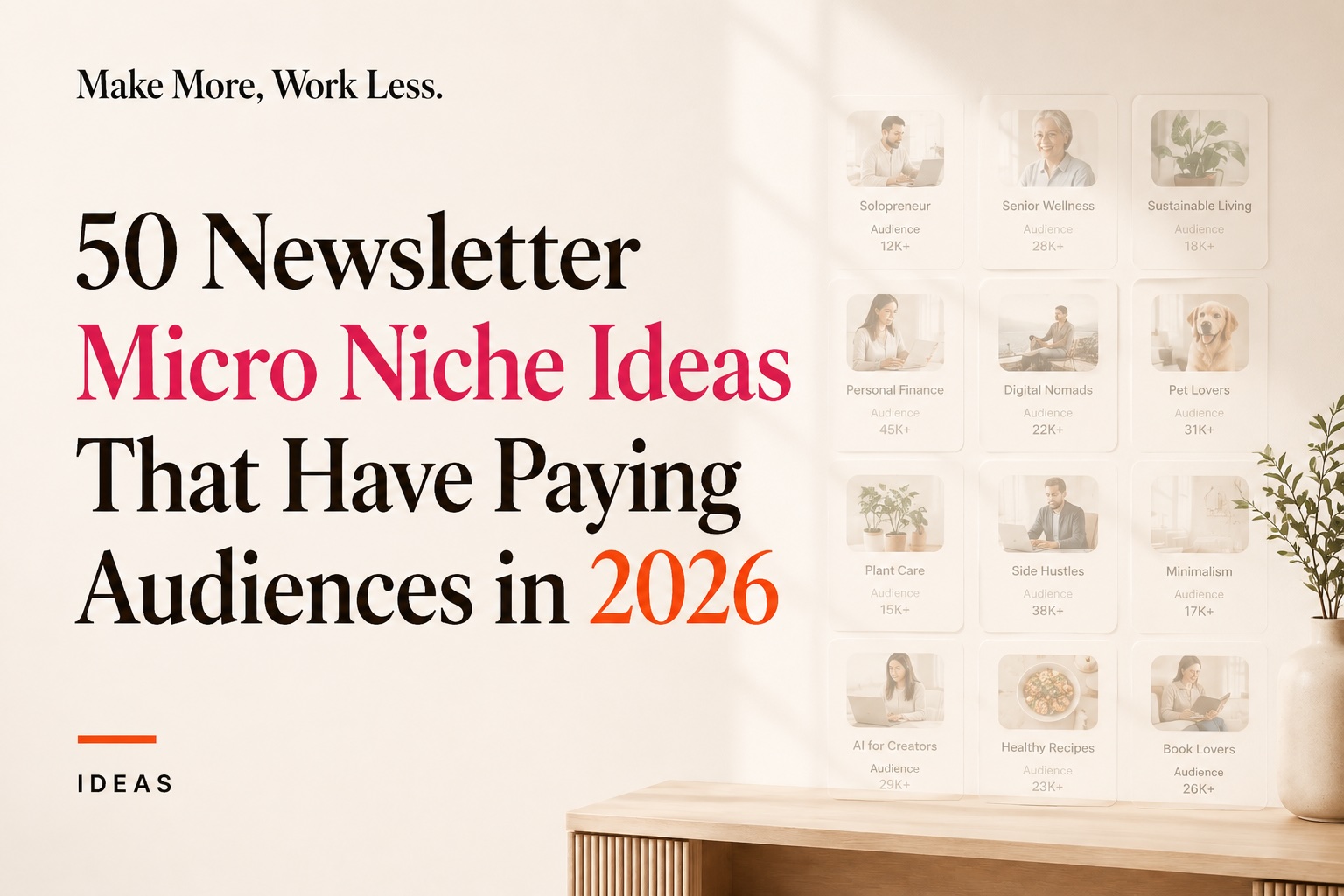
50 Newsletter Micro Niche Ideas That Have Paying Audiences in 2026
By Carrie Loranger | Last updated: June 25, 2026
The short answer: The most viable newsletter micro-niches in 2026 sit inside Finance & Money, Tech & AI, Career & Professional, Health & Wellness, Creator Economy, Parenting & Family, Local/Community, and Lifestyle & Travel. Niching down from "personal finance" to "first-gen wealth builders" or from "health" to "perimenopause for corporate women" is what separates newsletters that convert at 4–10% paid from those stuck at 1–2%. This article gives you 40+ verified micro-niche ideas, a framework for validating yours, and a checklist to confirm your niche has real paying potential before you write a single issue.
If you've ever felt like your newsletter idea is "too small," the data says the opposite is true. According to Best Writing's 2026 Substack statistics, specialized and niche publications convert free subscribers to paid at 4–10%, compared to the platform-wide average of 3% and the 1–2% rate for large general-audience newsletters. A focused niche is not a liability. It is the mechanism.
This isn't a post about how to run a newsletter business. It's a post about helping you find the right niche — one with a real audience, a real problem, and real purchasing power — before you launch.
Why Does a Micro-Niche Beat a Broad Niche for Newsletter Growth?
Micro-niche newsletters consistently outperform broad ones on every metric that matters for monetization. Specialized newsletters see 40–55% open rates versus 15–25% for large general lists, and click-through rates averaging 8.5% vs. 2.1% for broader newsletters, according to The Bright Path's analysis of niche newsletter performance. On the sponsor side, CPM rates for niche professional newsletters run $45–75 compared to $15–25 for general audiences — the same advertiser pays 3x more to reach 1,000 of exactly the right people.
The conversion math is even sharper when you look at paid subscriptions. On beehiiv, the platform-wide median free-to-paid conversion is 0.62%, but the top 10% of finance newsletters convert at 18–20% — a 26x gap within the same vertical. That gap is not explained by audience size. It is explained by specificity, positioning, and whether the reader believes you are writing to them alone.
Here's what the data shows when you compare broad versus micro-niche performance:
Sources: Bright Path, beehiiv State of Paid Newsletters 2026, ProblogInsights
The mechanism is simple: every email you send is relevant to every subscriber. There is no segment that tunes out because you strayed off-topic. That is why micro-niche email lists convert at up to 6x the rate of broad-topic lists according to conversion data across multi-site portfolios published by ProBlogInsights.
Broad niches feel safer because they seem bigger. But "business" is a category. "Bootstrapped SaaS founders navigating their first $10K MRR" is an audience.
What Is the Micro-Niche Validation Triangle?
The Micro-Niche Validation Triangle is a three-point framework for evaluating whether a newsletter niche is fundable before you commit. A niche that hits all three points — Pain, Passion, and Purchasing Power — has the structural ingredients for a monetizable newsletter. A niche that hits only two will likely grow or convert, but rarely both at the same time.
Pain: Does the Reader Have a Real, Recurring Problem?
A pain-qualified niche is one where readers face a problem that returns regularly — not a one-time question they can Google once and move on. The best newsletter pains are ones where the landscape keeps shifting (regulatory changes, new tools, evolving platforms), where the cost of being wrong is high (money, career, health), or where the reader is surrounded by noise and desperately wants a trusted filter. A newsletter about "how to use AI in your small business" has recurring pain because AI tools change monthly. A newsletter about "how to write your first resume" solves a one-time problem.
Passion: Does the Reader Actively Seek Content About This?
A passion-qualified niche is one where people already gather — in subreddits, Facebook groups, Slack communities, Discord servers, or Substack comment threads. You should be able to find at least three places where your target reader congregates before you launch. Passion validates that people consider this topic part of their identity, not just a problem to solve. It also means organic word-of-mouth is possible: passionate readers forward newsletters. According to beehiiv's State of Newsletters 2026, entertainment, sports, and history categories (all passion-led) consistently hit 45–53% open rates, well above the 41% platform average.
Purchasing Power: Does the Reader Have Budget to Spend on Solutions?
A purchasing-power-qualified niche is one where readers spend money — on tools, courses, services, memberships, or subscriptions — to solve the problem or deepen their involvement in the topic. This doesn't require a wealthy audience. It requires an audience where the niche is a spending category. B2B professionals expense subscriptions. Investors treat newsletter fees as a research cost. Parents spend on parenting solutions. A 1,000-subscriber investing newsletter can generate $2,700/year; the same-size travel newsletter generates roughly $252/year, per Creator's MBA's paid newsletter benchmarks. Same audience size, different purchasing power.
How Do the Top Substack Categories Perform in 2026?
Substack has 29 official categories. According to NicheIndex's 2026 analysis of 24,467 Substack newsletters, Finance leads in median price at $25/month, Technology sits at $10/month, and Business at $9/month. The highest monetization rates by category go to Food & Drink (77.9%), U.S. Politics (77.4%), Health & Wellness (77.3%), and Faith & Spirituality (77.2%) — meaning creators in those categories are most likely to have a paid tier active.
The categories that dominate top-earner revenue, per Press Gazette's analysis of the 52 highest-earning Substack publications, are U.S. Politics (46% of total top-earner revenue), Finance, Technology, and Business. But those four categories also have the highest competition. The opportunity for new creators in 2026 lies in the micro-niches underneath them — the specific corner of Finance, Health, Tech, or Career where no one has established authority yet.
Finance, Business, U.S. Politics, Technology, and Health Politics are the five highest-earning Substack categories by total revenue, according to Best Writing's 2026 Substack statistics. The micro-niche strategy is to pick the right sub-segment of one of these verticals, or an adjacent category where passion and purchasing power are both high.
What Are the Best Newsletter Micro-Niche Ideas for 2026?
The following 45+ micro-niches are organized by category. Each includes a one-sentence description of the specific reader it serves. These are not broad categories — they are the niche inside the category that gives a new creator a realistic path to authority.
Finance & Money
First-gen wealth builders — Adults who grew up in households without investing or generational wealth, navigating their first brokerage accounts, student loan payoffs, and homeownership.
Freelancer financial planning — Self-employed creatives and consultants managing irregular income, quarterly taxes, solo 401(k)s, and insurance gaps.
Women and divorce finances — Women navigating asset division, credit rebuilding, QDRO retirement splits, and financial independence after a marriage ends.
Corporate-to-entrepreneur money transition — Professionals leaving six-figure salaries who need to rethink their tax structure, benefits, and cash flow before they quit.
High-income earners with lifestyle inflation — Professionals earning $150K+ who are still living paycheck-to-paycheck and want specific strategies to stop it.
Real estate micro-investing — Non-accredited investors exploring REITs, fractional ownership platforms, and small-deal house hacking on a middle-class budget.
International remote workers and taxes — Digital nomads and expats managing multi-country income, FEIE, and banking across borders.
Tech & AI
AI tools for solopreneurs — One-person businesses applying AI to replace expensive hires, automate repetitive tasks, and build lightweight systems without a technical background.
Prompt engineering for content creators — Writers, podcasters, and newsletter creators building reusable AI workflows for research, drafting, and distribution.
No-code builders weekly — Non-technical founders using Bubble, Glide, Make, and Zapier to ship products without hiring developers.
AI in healthcare for practitioners — Clinicians, therapists, and healthcare administrators monitoring FDA-cleared AI tools and regulatory updates shaping their workflows.
Cybersecurity for small business owners — Non-technical business owners who need plain-English coverage of threats, insurance requirements, and affordable protective tools.
Hardware and gadgets for power users — Productivity-obsessed professionals who want independent, deeply-tested reviews of tools, peripherals, and home office setups.
Career & Professional
Mid-career reinvention at 40+ — Professionals in their 40s and 50s navigating industry pivots, credential gaps, and rebranding after spending 15+ years in one field.
Tech layoff recovery — Former FAANG and tech employees rebuilding income through consulting, adjacent careers, or entrepreneurship after a layoff.
First-time managers — Individual contributors who just got promoted and are navigating difficult conversations, performance reviews, and team dynamics for the first time.
Women in male-dominated industries — Women in tech, finance, construction, or energy sharing career navigation strategies specific to environments where they are the minority.
Remote work career advancement — Distributed workers who worry about being invisible and want strategies for visibility, promotion, and raises without being in the office.
Corporate side hustlers — Full-time employees quietly building a second income stream and managing the tension between their job and their growing outside project.
Job searching in your 50s and 60s — Experienced professionals navigating age discrimination, resume modernization, and ageist hiring practices in a competitive market.
Creator Economy
Newsletter monetization beyond subscriptions — Newsletter creators who already have a list and want a clear roadmap to digital products, sponsorships, and community offers.
Substack growth for niche creators — Writers outside politics and finance who want to grow on Substack without being political commentators or financial analysts.
Podcast-to-newsletter bridge — Podcasters repurposing audio content into searchable, monetizable email newsletters to create a second distribution channel.
Short-form creators building owned channels — TikTok, Reels, and Shorts creators who want to convert algorithm-dependent audiences into owned email subscribers.
LinkedIn-to-newsletter pipeline — B2B professionals turning LinkedIn content and followers into a monetizable newsletter with a defined offer stack.
Creator collaboration and licensing — Established creators exploring content licensing, co-brands, and collaboration deals as an additional income stream.
Health & Wellness
Perimenopause and menopause for career women — Professional women 38–55 navigating hormone changes, brain fog, sleep disruption, and fatigue while managing demanding careers.
Mental health for high achievers — Executives, founders, and high-performance professionals managing anxiety, burnout, and identity tied to work in a culture that rewards overwork.
Chronic illness and work — People managing diagnoses like POTS, endometriosis, fibromyalgia, or autoimmune disease while trying to maintain a career and income.
Functional medicine and root-cause health — Health-conscious readers who have left conventional medicine and want research-based guidance on labs, supplements, and protocols.
Men's health and longevity over 40 — Men focused on testosterone optimization, muscle preservation, metabolic health, and preventive biomarker tracking as they age.
Sober curious and mindful drinking — Adults who are reconsidering their relationship with alcohol without committing to total abstinence, wanting community and science-backed information.
Parenting & Family
Gifted and twice-exceptional kids — Parents navigating school advocacy, IEPs, and the unique emotional needs of children who are both intellectually advanced and have learning differences.
Parenting kids with ADHD — Parents of ADHD children navigating diagnosis, school accommodations, medication decisions, and behavioral strategies across different ages.
Sandwich generation caregiving — Adults in their 40s and 50s simultaneously raising children and managing the care and finances of aging parents.
Parenting as a solopreneur — Self-employed parents building businesses around school schedules, childcare constraints, and the financial uncertainty of entrepreneurship.
Multicultural parenting — Families raising bicultural or multilingual children who want to preserve heritage languages and identity in a dominant-culture environment.
Local & Community
Local real estate market intelligence — Residents of specific metro areas who want hyperlocal data, zoning news, and neighborhood-level real estate analysis unavailable in national outlets.
Local food and restaurant culture — Residents of a city or region who want independent editorial coverage of the local food scene that goes beyond Yelp aggregation.
Small-town civic intelligence — Residents of smaller cities and towns who want clear, non-partisan coverage of local government, budgets, and civic decisions that affect them directly.
City-specific professional networking — Professionals in a specific metro area who want curated events, introductions, and career opportunities within their local market.
Lifestyle & Travel
Slow travel and long-stay travel — Travelers interested in 2–6 week stays in one place, seeking practical guidance on visas, accommodation, cost, and community in specific destinations.
Travel hacking for families — Parents who want to use points, miles, and credit card strategies to travel with kids without paying full retail prices.
Luxury travel on a realistic budget — Aspirational travelers who want premium experiences — business class, boutique hotels — through strategic credit card and points optimization.
Outdoor adventure and gear minimalism — Hikers, climbers, and backcountry travelers who want gear reviews and trip planning advice focused on doing more with less.
Van life and overlanding for adults 40+ — Professionals and retirees exploring long-term vehicle-based travel who need age-specific perspectives on rig setup, safety, and community.
What Questions Should You Ask Before Committing to a Newsletter Niche?
A niche that passes the Micro-Niche Validation Triangle still needs one final filter before you commit. These three checklist questions translate the framework into a practical go/no-go decision you can complete in an afternoon.
Question 1: Does this audience have a problem they'll pay to solve?
Search for what your audience buys — courses, coaching, software, books, events, subscriptions. If there's a thriving market of paid solutions already, your audience has proven purchasing behavior. If the only resources are free blog posts, either the problem isn't painful enough or the audience doesn't have purchasing power. Look at Amazon categories, Gumroad bestsellers, Udemy enrollment numbers, and the sponsorship pages of existing newsletters in the space.
Question 2: Is there a community already forming around this topic?
Before your newsletter exists, your audience should already be gathering somewhere. Search Reddit, Facebook Groups, Slack communities, Discord servers, and existing Substack comment threads. A community that's already self-organizing is a validation signal that people consider this topic part of their identity — not just a passing interest. If you can't find three places where your target reader congregates, the niche may be too narrow to sustain subscriber growth through word-of-mouth.
Question 3: Can you build authority here in 90 days?
Authority is relative to the competition, not absolute. In a micro-niche, you don't need a PhD — you need to be the most consistent, most specific, most trusted voice for that particular reader. Ask: is there a corner of this topic where I have lived experience, professional background, or obsessive firsthand knowledge that others don't? If the answer is yes, you can plausibly establish authority in 90 days of consistent publishing. If you're planning to learn the topic as you write, you'll build audience trust more slowly — not impossible, but factor it in.
According to WifiTalents' 2026 newsletter industry statistics, micro-newsletters (under 5,000 subscribers) now account for 60% of all new entries into the creator economy, which means your competition in any micro-niche is low, but your path to standing out requires a clear authority claim from day one.
How Do You Know If Your Niche Is Profitable, Not Just Popular?
A niche can have a large, enthusiastic free audience and still produce almost no paid subscriber revenue. The data from Creator's MBA's benchmarks is stark: a 1,000-subscriber investing newsletter generates approximately $2,700/year in paid subscriptions, while a 1,000-subscriber travel newsletter generates roughly $252/year. The niche sets your revenue ceiling more than your list size does.
Profitability signals to look for before launching:
Existing paid newsletters in the space: If someone is already charging $10–$25/month for content in this niche, the audience has demonstrated willingness to pay.
Active sponsorship market: Finance newsletters command CPMs of $50–$120; lifestyle newsletters average $15–$25, per The Inbox Founder's analysis of profitable newsletter niches.
Adjacent product purchases: Does your target reader already buy books, courses, software, or coaching in this area? If so, they will buy from you.
B2B adjacency: If your reader can expense your newsletter or deduct it as a professional development cost, conversion rates climb. KeyGroup's Substack data shows Professional Services newsletters achieving 14% free-to-paid conversion — the highest tracked rate across categories.
The beehiiv State of Paid Newsletters report confirms that paid subscriptions for niche creators on beehiiv jumped 138% year-over-year in 2025, driven specifically by "niche creators who deliver specialized expertise." The market is rewarding focus, not scale.
Frequently Asked Questions
What is a newsletter micro-niche?
A newsletter micro-niche is a tightly defined topic that serves a specific, identifiable reader with a particular problem — not a broad category like "health" or "business." Examples: "perimenopause for corporate women" or "bootstrapped SaaS founders at $10K MRR." Micro-niches convert free readers to paid subscribers at 4–10%, versus 1–2% for broad-topic newsletters.
How do I find a profitable newsletter niche in 2026?
Apply the Micro-Niche Validation Triangle: confirm your reader has (1) a real, recurring Pain, (2) Passion — meaning they actively seek content and community around this topic — and (3) Purchasing Power, demonstrated by existing paid products, courses, or services in the space. A niche that hits all three is fundable. Then run the three-question checklist: paying audience, existing community, and 90-day authority path.
Which newsletter niches make the most money in 2026?
Finance, Technology, and Professional Services newsletters command the highest paid subscription prices and conversion rates. Finance newsletters on Substack have a median price of $25/month and the top 10% of finance creators on beehiiv convert at 20%, per beehiiv's State of Paid Newsletters 2026. B2B professional services newsletters show a 14% free-to-paid conversion rate. For new creators, the opportunity is in the micro-niche beneath these broad categories.
How many subscribers do I need to make money from a newsletter?
Revenue is driven more by niche and conversion rate than by raw subscriber count. A 1,000-subscriber investing newsletter generates approximately $2,700/year at a 3% paid conversion rate and $10/month. A general lifestyle newsletter with the same 1,000 subscribers generates roughly $252/year. Building your first 1,000 subscribers in the right niche — with the right offer architecture — produces more revenue than 5,000 subscribers in the wrong niche.
Is Substack or beehiiv better for a new niche newsletter?
Both platforms support monetized niche newsletters effectively. Substack has built-in discovery, a social network (Notes), and a large existing reader base — advantages for new creators building audience from scratch. Beehiiv offers stronger analytics, segmentation, and monetization tools for creators who already have traffic or an existing audience to import. Kit (formerly ConvertKit) remains the platform of choice for creators who plan to run complex automation and digital product funnels alongside their newsletter.
Can a newsletter in a small niche grow to 1,000 subscribers?
Yes. According to the 2026 Creator Economy Report data cited by Alun Hill, accounts in specific micro-niches (under 5,000 followers) convert social audiences to newsletter sign-ups at up to 18%, compared to 0.4% for large generalist accounts. Small niche, focused content, and consistent distribution outperforms broad reach for owned-channel growth.
How do I validate a newsletter niche without launching first?
Three steps: (1) Search for existing paid newsletters in the space — if someone charges $10+/month and has subscribers, demand exists. (2) Find three communities where your target reader already gathers (subreddits, Facebook Groups, Discords). (3) Build a one-page landing page and run $50–100 in traffic to it; if you hit 5%+ sign-up conversion, the niche has pull. This test costs less than a month of writing to an unvalidated audience.
What is the Micro-Niche Validation Triangle?
The Micro-Niche Validation Triangle is a framework created by Carrie Loranger for evaluating newsletter niche viability. Its three points are Pain (the reader has a real, recurring problem), Passion (the reader actively seeks content and community about this topic), and Purchasing Power (the reader already spends money on solutions in this space). A niche hitting all three is fundable; hitting only two will produce either audience or revenue, but rarely sustainable growth in both.
Work With Carrie: Substack Strategy and Newsletter Growth
If you're ready to launch and want to build your first 1,000 Substack subscribers with the right strategy from day one, the Get Your First 1,000 Substack Subscribers guide ($37) walks you through the exact positioning, growth, and content system I used to reach 9,000+ subscribers in 15 months on 9-to-Thrive.
Once you've validated your niche, here's how to work deeper with the strategy:
For more on turning your newsletter into multiple income streams, read How to Make Money From a Newsletter and How to Build Multiple Income Streams as a Creator. If you haven't launched yet, start with How to Start a Substack Newsletter in 2026.
Subscribe to 9-to-Thrive at thrivewithcarrie.substack.com — published every Tuesday and Saturday.

